Showing posts with label culture. Show all posts

Thursday, 6 November 2014

BEHIND THE GOTHIC FACADE – A MEETING WITH SIMON TAXACHER IN HOTEL COPERNICUS (KRAKÓW)


A few years ago I stumbled upon a magazine article about Hotel Copernicus in Kraków. Just two things from the article have stuck in my mind: the hotel's Medieval origins and a wonderful view of the Wawel Castle stretching from the roof terrace. The hotel is often visited by celebrities staying in Kraków (including my favourite actor, Benedict Cumberbatch) but because I'm definitely not a celebrity, the only thing I could do was to stroll along quaint Kanonicza street and wonder what's hidden behind this impressive Gothic facade.


However to my great surprise and delight, a few weeks ago I received an email inviting me for “snacks” and a press conference with a famous Austrian chef Simon Taxacher, which was going to take place in the Hotel Copernicus itself. As you can guess, I couldn't miss such an opportunity. :)


The meeting took place on the 17 October 2014 as part of the prestigious Gourmet Relais & Châteaux Festival, whose highlight was a seven-course dinner prepared by Simon Taxacher, an acclaimed chef (awarded numerous prizes, including 2 Michelin stars) and the owner of an Alpine hotel and restaurant Rosengarten in Tyrol, Austria.


Here are a few interesting facts that caught my attention during the conversation around a solid, wooden table in the hotel restaurant.
  • Simon Taxacher combines regional products from Tyrol with ingredients from other countries so that his cuisine is both local and varied
  • he pays a lot of attention to not only the look and structure of his dishes, but also the tableware on which they're served
  • because he usually works up to 16 hours a day in his restaurant, at home he prepares only simple, quick dishes
  • he values team-work and thinks highly of his co-workers
  • even though he's pleased with the awards and praises, he always cooks to please his clients, not critics   

The “snacks” mentioned in the invitation email were actually three of the seven dishes from the menu prepared for the festival dinner. The food was not only delicious but also beautifully served. Some dishes looked like little pieces of art. Sommelier Andreas Katona matched the food with Austrian wines. And this is what we had a chance to eat:


Beetroots (old variety), sea-buckthorn, cottage cheese


According to Mr Taxacher, the beetroots are grown in a traditional way in Tyrol. They were served with mountain cottage cheese, sea-buckthorn and beetroot juice meringue. All the ingredients created a perfect blend of flavours but I especially liked the delicious, creamy cottage cheese made by the chef and his team from Alpine cow milk. The beetroots were served with 2012 Grüner Veltliner wine with a spicy, black pepper flavour.

Veal cheek, date malt, Jerusalem artichoke


Apparently beef cheek meat is a relatively rare restaurant dish as it's often used for veterinary inspections. That's why the chef has to cooperate with a vet who won't destroy the meat structure during the check-up. I can't say anything about the veal cheek as I don't eat meat but Ada from blog Pora coś zjeść praised its taste and tenderness. In the meantime, I happily nibbled at the date sauce and all the titbits served with the meat, especially Jerusalem artichoke – a traditional but now forgotten vegetable which is slowly coming back into culinary fashion. Even though I'm not a great fan of red wine, I fell in love with 2009 pinot noir from a small Austrian vineyard. It was definitely one of the best wines I've ever tried.

Garden - plums, nitro-chocolate, gin and tonic


For dessert, we had nitro-chocolate, in other words chocolate foamed with liquid nitrogen and tasting like something between chocolate mousse and ice cream. It was served with a delicious plum sauce, gin and tonic mousse and fresh clovers. The pink dessert wine Rosenmuskateller had a pleasant rose flavour but was a tad too sweet for my liking.


The whole meeting passed off in a pleasant atmosphere. I left the hotel with new culinary experiences, new acquaintances and a box filled with delicious things from Tyrol (including my favourite elderberry syrup). Finally, I discovered what's hidden behind the Gothic facade of the Hotel Copernicus and I must admit reality exceeded my (already high) expectations.


PS. I would like to thank the owners and staff of Hotel Copernicus for their invitation, professional organization of the meeting and a warm welcome. Special thanks to Simon Taxacher and his whole team for preparing all the delicious dishes and for sharing with us his culinary expertise. It was a great pleasure to meet you all. :)


Address: Hotel Copernicus, Kanonicza 16, Kraków (Old Town)

Address: Hotel Restauracja Spa Rosengarten
Aschauerstrasse 46, 6365 Kirchberg, Tyrol, Austria


Gourmet Relais & Châteaux Festival: www.gourmetfestival.pl


Sunday, 6 July 2014

ARTISTIC PICNICS WITH A HINT OF MELANCHOLY

Aleksander Gierymski, , In the Arbour, 1882, fragment
Eating on the grass is not only a pleasant way to spend a summer afternoon, but also a graceful subjects of numerous art works. Thanks to the invention of paints in tubes, painting in the open air became much, much easier in the 19th century and artists could show their friends what they ate during their picnic even before Instagram.

Auguste Renoir, Luncheon of the Boating Party, 1880-1881
The picnic paintings were especially popular in France, where Manet created his famous The Luncheon on the Grass (Le Déjeuner sur l'herbe) and Renoir painted Luncheon of the Boating Party (Le déjeuner des canotiers). Similarly, some Polish 19th-century painters created picnic paintings and the two most interesting examples include In the Arbour (W altanie) by Aleksander Gierymski and The May Sun (Słońce majowe) by Józef Mehoffer.

Aleksander Gierymski, , In the Arbour, 1882
Let's look at this idyllic scene in the garden. Two elegant but slightly bored ladies in wigs and exquisite dresses are sipping tea and listening to the conversation of the men drinking wine. The wine-skin lying on the ground suggests that this stiff party is slowly warming up. This picture, titled In the Arbour, was painted in 1882 by Aleksander Gierymski – an artist working in Warsaw, Cracow and Rome. The sitters are dressed up in the clothes from the rococo era – an 18th-century artistic movement famous for its bucolic genre scenes filled with charming shepherds and shepherdesses, cheerful putti and pale, pastel colours.

Jean-Antoine Watteau, Les Champs Elysées, 1717-1718
Gierymski's painting alludes to the artistic and literary tradition of hortus deliciarum - the garden of earthly delights. However – unlike the playful, carefree rococo scenes – In the Arbour has an air of melancholy. Even though the arbour is bathed in warm golden sunlight and the picnickers are drinking appetizing beverages, their eyes are sad, pensive, as if some deeper sense of unease lurked under the mask of the idyllic carefreeness. 

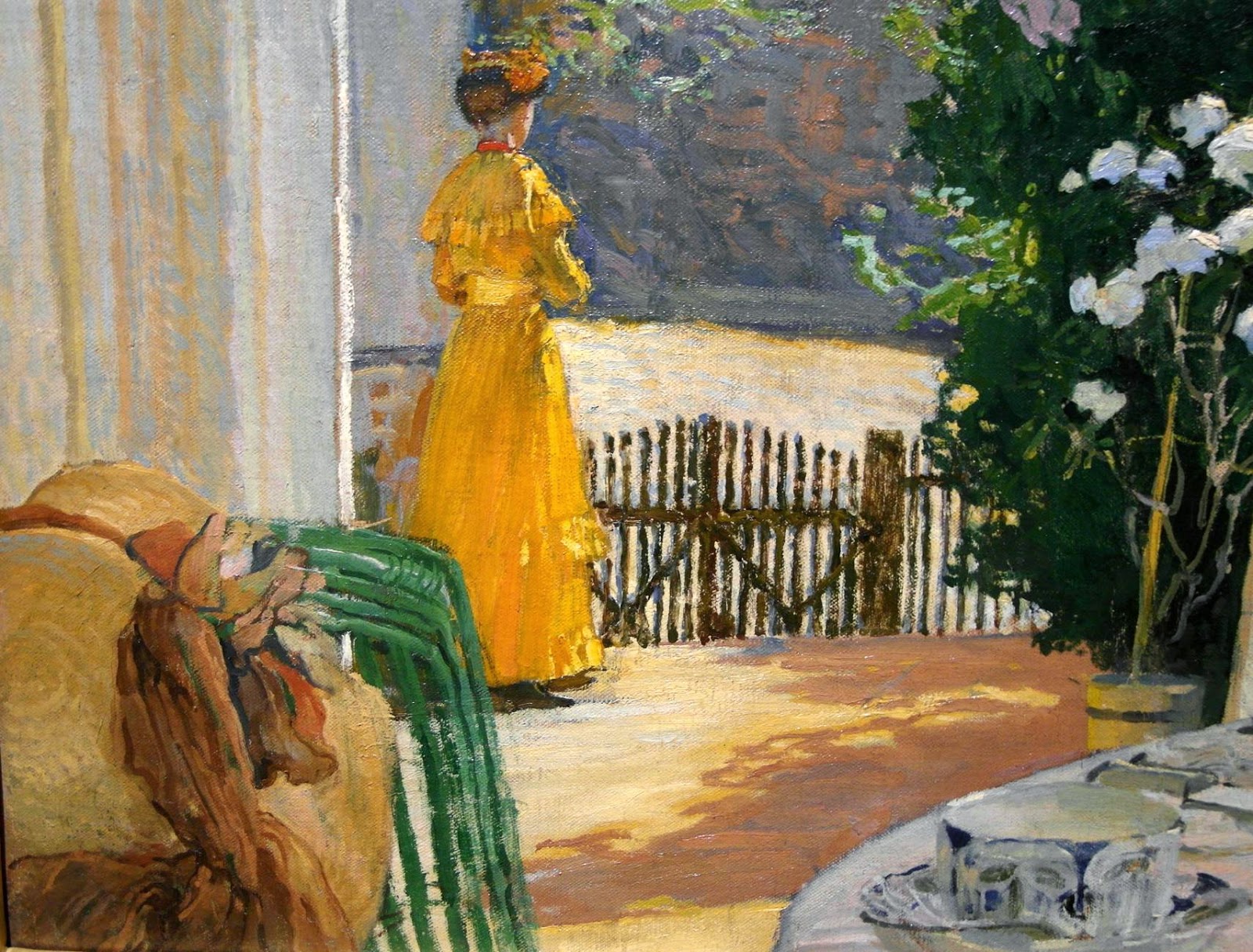
Józef Mehoffer, The May Sun, 1911
Similar melancholy pervades The May Sun (1911) by Józef Mehoffer, a renowned Polish painter and decorative artist, who was one of the leading exponents of the Young Poland movement. In 1897, Mehoffer wrote in his diary: “I've got a number of ideas of light, very sunny, colourful paintings. […] The general idea is: the idea od life – delight – pleasure – amusement – light – sun and warmth.” The most famous example of these sunny paintings is Strange garden with a mysterious dragonfly hovering above an the artist's wife and son standing in the orchard.

Józef Mehoffer, The Strange Garden, 1903
However, The May Sun seems to be equally enigmatic. It depicts a porch with a set table and the artist's wife standing next to the gate impatiently awaiting someone. The scene was painted in the artist's summer house in Janówka near Kraków, where Mehoffer spent a lot of carefree holidays with his family. The table is filled with two china cups, a green sugarbowl and a shiny samovar as if the artist was about to have tea with his beloved wife Jadwiga Janakowska. However, her folded arms and turned face suggest that there is some mystery in this Arcadian garden. Hot air filled with the scent of lilac on the porch seems to quiver with Jadwiga's hidden uneaseness.
Józef Mehoffer, The May Sun, 1911 fragment
Both canvases are wonderful examples of Polish painting at the turn of the 19th and 20th centuries. Perhaps because of the current historical situation in Poland, the artists of this period seemed unable to shake off the sense of sadness and anxiety, which pervades even these seemingly idyllic paintings. Interestingly, unlike their French fellow artists, neither Gierymski, nor Mehoffer painted any food on their picnic tables. Tea, wine and melancholy – this is all they could offer the people inhabiting their picnic scenes. 

Aleksander Gierymski, In the Arbour (1882), oil on canvas, The National Museum in Warsaw
Józef Mehoffer, The May Sun (1911), oil on canvas, The National Museum in Warsaw


Józef Mehoffer, The May Sun, 1911 fragment

The article has been printed (in Polish) in Magazyn Apety: link.

Józef Mehoffer, The Strange Garden, 1903, fragment

Sunday, 29 June 2014

CUISINE ON SCREEN - FOOD IN FILM


Do you also have an impression that there are more and more films in which food plays the leading role? Here's a short list of the most recent culinary films. I haven't seen any of them yet but they all seem to be an interesting view on the artistic side of food. :)

The Lunchbox – a subtle love story set in Mumbai. The role of the love's messanger is played by the curry lunchbox prepared lovingly by the main female character. Trailer


Delicious - a film about a romance between a young passionate cook (Nico Rogner) and a woman suffering from an eating disorder (Louise Brealey – better known as Molly from BBC 'Sherlock'). Trailer


Chef – a commedy about a visionary chef (Jon Favreau) who quits his job in a restaurant and opens his own food truck with Cuban sandwiches. The film is studded with American stars, including Robert Downey, Jr., Scarlett Johansson, Sofía Vergara and Dustin Hoffman. Trailer


Two Greedy Italians – a BBC programme about two famous chefs and food experts, Antonio Carluccio and Gennaro Contaldo, who travel around Italy talking with relish about the real Italian cuisine. Trailer


The Trip to Italy – a similar idea to “Two Greedy Italians” but, unlike the BBC programme, it is a feature commedy starring two famous British actors, Steve Coogan and Rob Brydon. Trailer


And what other films about food can you recommend? :)

PS. Before you go to the cinema, check out this hillarious trailer of Electric Cinema, one of the oldest working cinemas in London, and see how many British actors/celebrities you can recognize. :)  Trailer


Monday, 31 March 2014

FOOD IN ART AND LITERATURE – CONFERENCE HIGHLIGHTS

Cornelis de Heem, Still-Life with Oysters, Lemons and Grapes, 1660s (www.wga.hu)
A few months ago I attended an academic conference “Kultura jedzenia, jedzenie w kulturze” [Culture of Food, Food in Culture] in Kraków organised by Kultiwarium Festival. The programme was very diverse but I had time to take part in only one session: Artistic and Literary Aspects of Food. As an English literature and art history graduate I could not miss it for the world. :)

Pieter de Bloot, Christ in the House of Mary and Martha, 1637(www.wga.hu)
I especially liked the presentation called “Cena Non Finita. Tables, Pantries, and Victuals in the 17th-century Netherlandish Painting.” As the Latin title suggested, it was an unending feast – a feast of fruit, vegetables, meats and other delicacies painted with such a precision that one can discern even the particular varieties of grapes. Interestingly, these highly realistic paintings were not always painted from nature, as they often depict compositions of flowers or fruits which grow during different months or even seasons.

Frans Snyders, Still Life, 1635-1639 (www.wga.hu)
Apart from the purely aesthetic function, these appetizing still lifes had also many hidden meanings. There are a lot of various interpretations but the most popular motifs included vanitas, i.e. “vanity” in Latin (rotten fruit, withered flowers, unfinished meals); and religious themes (chalice with wine, bread). I also learned that lemon symbolised a false friend because it's beautiful from the outside but bitter inside, and cheese was considered by some Dutch and Flemish doctors to be the source of all the diseases. ;)

Salvador Dali, The Persistence of Memory, 1931 (source)

A presentation on edible beauty in Salvador Dalí's art also promised to be interesting. Though the speakers spent most of the time discussing Dalí's biography, they also mentioned some interesting connections between his art and food. I learned that his most famous painting “The Persistence of Memory” was inspired by Camembert cheese melting in the sun. Moreover, Dalí loved both his wife, Gala, and lamb chops so ardently that he decided to depict them together in one painting, placing raw chops on Gala's shoulder. Yummy. :P

Salvador Dali, Portrait of Gala with Two Lamb Chops Balanced on Her Shoulder, 1933 (source)
I found a lecture on grotesque descriptions of food in literature exceptionally funny. The speaker presented a surreal menu: six pilgrims in a salad from “The Life of Gargantua and of Pantagruel,” sturgeon of the second freshness from “The Master and Margarita,” and some absurd dishes from Stanisław Ignacy Witkiewicz's play “The Shoemakers,” as well as humorous poems by the Polish Nobel Laurate Wisława Szymborska.

Witkacy, Stworzenie świata, 1921-1922 (source)
For dessert, we were served a passionate speech on fat body of white men in crime novels. One of the examples was my favourite Agatha Christie's Hercule Poirot, whose plumpness and misleadingly benign looks often gave him an upper hand. By the way, did you know that Poirot's name has the same pronunciation as “poireau,” a French word meaning leek? :)

Hercule Poirot played by David Suchet in the ITV television series (source)

I'm really glad I could take part in the conference on food and culture. All the presentations were very well prepared and engaging. However, I think the topic of food in painting and literature is so broad that it deserves its own conference, not only one session. What do you think? 

Conference website: http://www.kn.psc.uj.edu.pl/ and facebook
Kultiwarium website: http://www.kultiwarium.pl/
Titles of all the presentations in Polish:

PANEL XII - ARTYSTYCZNE I LITERACKIE OBLICZA KUCHNI

1. Cena non finita. Stoły, spiżarnie i wiktuały w siedemnastowiecznym malarstwie niderlandzkim – motywy i interpretacje - ALINA BARCZYK
2. Jadalne piękno – pierwiastki kulinarne w surrealistycznej twórczości Salvadora Dalego - ŁUKASZ KURP, IZABELA STĄPOR
3. Nie tylko magdalenki... Groteskowe obrazy kulinariów i ucztowania w literaturze - ANNA KUCHTA
4. Smaki literackiego stołu. Kulinarne preferencje bohaterów polskiej prozy najnowszej - ANNA FIGA
5. Jedzenie w powieści kryminalnej: co o detektywie i męskości mówi grube ciało? - MARTA USIEKNIEWICZ

Sunday, 9 March 2014

BRUEGEL'S FIGHT BETWEEN CARNIVAL AND LENT – FOOD FIGHT


I'm happy to present another essay from my new series on food in art and literature. This time the cultural menu includes carnival waffles, Lenten fish, and a fashionable hat stuffed with meat. :)


This week marked the end of Carnival, a festive season of celebrations, revels and food, followed by the beginning of Lent, the time of penance, prayer and.... also food, or more specifically, Lenten dishes. The tension between these two seasons is brilliantly captured in the painting 'The Fight Between Carnival and Lent' by an imminent Flemish painter, Pieter Bruegel the Elder (1559). 


The painting is divided into two sections: a cheerful carnival procession gathered around numerous inns, plays, and masquerades on the left side; and a more solemn crowd of parishioners leaving the church and giving alms to the poor – on the right. However, what these two sides have in common is food, especially dishes and culinary utensils grotesquely depicted as clothes or fashion accessories.  


The foreground is dominated by two fighting figures: chubby Carnival (Mardi Gras) and emaciated Lent wearing a nun's habit. Carnival sits astride a beer barrel decorated with a piece of meat, he wields a spit with a pig's head and sausages and wears a fashionable hat in the form of a meat pie. There's no doubt this man is a meat-lover, or even a butcher as the knife hanging from his belt may suggest.


Carnival's entourage is as elegant as its ringleader. Just behind him, there's a woman carrying on her head a tasteful table with biscuits and a traditional carnival dish - waffles. Another lady flaunts an egg necklace, while a man in the bottom left corner has three big waffles strapped to his hat. Undoubtedly, it's a great way to distract his gambling opponent. ;)


Thanks to Bruegel's painting we can also see how carnival waffles were prepared in the 16th-century Low Countries. In the middle of the square there's a lady making the batter in a pot directly on the ground and baking the waffles over an open fire. I wonder what Health and Safety would say to all that...


Lent's procession is also equipped with food, though it doesn't look as appetizing as Carnival's. The figure leading the penitents wears a beehive on her (his?) head and has some Lenten 'delicacies' under her feet: hard tack, pretzels and mussels, which were once considered poor man's food. She's armed with a baker peal with two measly herrings and behind her back you can notice a stall selling Lenten fish.


Interestingly, Medieval believers tried to evade the ban on eating the meat during Lent, for example by claiming that birds are 'creatures of the sea' because they were created by God on the same day as fish. Even beavers were considered to be fish because of the scales on their tails. Apparently the term 'fish' was much broader in the Middle Ages than today.


Bruegel's painting depicts an allegoric fight between an urge to play and an urge to pray, between the flesh and the spirit. It also reflects a historic conflict between Catholics, who observed the Lent, and Protestants, who thought it was obsolete. But basically it's just a hilarious and grotesque glorification of food in all its aspects: from Lenten hard tack to delicious waffles.


Pieter Bruegel (Brueghel) the Elder, The Fight Between Carnival and Lent, 1559, oil on wood, 118 cm x 164 cm, Kunsthistorisches Museum, Vienna


Works cited:

Jennifer McGavin, Lent in the Middle Ages – Fastenzeit, 

Andrew Graham-Dixon, ITP 150: The Fight Between Carnival and Lent by Pieter Bruegel the Elder, 02. 03. 2003, 

Saturday, 8 February 2014

FILM AMÉLIE – HOW FOOD CONNECTS KIND PEOPLE


Welcome to the first part of my new series: food in art and literature. I'd like to start with "Amélie" – my favourite film about love, loneliness and, of course, food.


I'm sure you all remember the famous food scenes, such as Amélie's delight in cracking crème brûlée or the way she ate raspberries off her fingertips. Actually, the topic is so vast that one could write a whole book about food and drink in this film. But this time I've decided to focus only on how food helps the characters (especially the nice ones) connect with others, proving that Julia Child was right – "People who love to eat are always the best people".


Eating in France is a form of a social ritual. Friends and families gather around the table, munching at French delicacies, sipping wine and enjoying each other's company for hours on end. This social function is visible in the film in the café where Amélie works as a waitress. In Des 2 Moulins café on Montmartre in Paris, patrons drink kir (white wine with crème de cassis, or blackcurrant liqueur) and mauresque (anise–flavored liqueur called pastis mixed with almond syrup) and have long discussions about love, life, and latest gossip.


In stark contrast to this lively place, there is a melancholic scene of Amélie cooking pasta only for herself. She looks out of the window and notices her neighbour, 'The Glass Man', who also has dinner in absolute solitude. Fortunately, after a while the two become friends and spend time together eating speculoos (Dutch ginger biscuits) dipped in mulled wine. (By the way, it seems to be a peculiar choice of snacks for a hot summer, don't you think? ;))


The Glass Man also connects people over a meal in another, more metaphorical way – each year he paints a copy of Renoir's “Luncheon of the Boating Party” and every time he paints different dishes on the table. “They look quite happy there”, says Amélie. “They should be”, he replies. “This year they had hare with morels. And waffles with jam for the children”. :)

Luncheon of the Boating Party, Renoir, 1880-1881, source: wikipedia  
Love for food also helps some of the characters win over new friends, especially in the case of a mentally challenged Lucien. Working for the greengrocer, Lucien treats every fruit and vegetable like a precious treasure that should be handled with respect and gentleness. Amélie, who herself appreciates small pleasures, such as plunging her hand deep into a sack of grain, understands his childlike need to take delight in everyday life. That's why there's a thread of understanding between these two characters, both of whom dislike Lucien's surly, philistine boss, Mr. Collignon.


Similar joie de vivre (and joie de manger) characterizes Dominique Bretodeau, a man who used to live in the same house as Amélie. Every week Bretodeau buys a fresh chicken at the market, roasts it and savours the most delicate pieces of meat. However since the split with his daughter many years ago, this weekly ritual serves as a painful reminder of his loneliness. But thanks to Amélie's intervention, he decides to reconcile with his daughter and towards the end of the film we can see a heart-warming family reunion: Dominique carves a roasted chicken but this time he doesn't eat the best morsels himself – he gives them to his little grandson. Once again food becomes a means of showing love and affection.


And the most moving scene in the whole film is the baking scene. At the end of the film, Amélie makes her famous plum cake (identified by some bloggers as kouign-amann), fantasizing that she prepares it for her sweetheart, Nino. When she notices that she's run out of yeast, she imagines Nino running to the shop downstairs, buying yeast and quietly coming back home to surprise her. When she realizes that it is a cat, not Nino, who has actually entered the kitchen, she bursts into tears. However in some magical way the cake baking really brings Nino to Amélie's apartment and the whole story has a happy ending. I only wonder if Amélie and Nino have finally managed to bake and eat the plum cake? ;)


Amélie (French: Le fabuleux destin d'Amélie Poulain), directed by Jean–Pierre Jeunet, France 2001.

PS. Tomorrow I will post a review of a French restaurant Zakładka, whose interior seems to be inspired by "Amélie". :)